Sudoku Solver
Experimenting with different AI algorithms to solve variant Sudoku puzzles
Overview
Variant Sudoku describes a class of puzzles that riff on the traditional Japanese puzzle game. These puzzles add new constraints on top of the standard 1-9 in every row, column, and box (for example, the Anti-Knight constraint prevents the same digit from appearing one chess knight’s move away from itself). For the final project in my AI course, I developed an algorithm that could efficiently solve many of these different rulesets.
Technology Stack
- Language: Java
- Other Tools: Maven
Algorithm
The solver utilizes Depth-First Search (DFS) to iterate through different board states until a solution is found. To reduce the search space, I introduced a constraint validation function to eliminate impossible states as soon as they were found, such as the same digit appearing twice in a single row. I call this implementation the “naive” algorithm because it is the common approach for quickly solving standard Sudoku puzzles.
After this, I implemented domain pruning, followed by a Minimum Remaining Values (MRV) heuristic. After implementing this search, I saw my first major increase in performance. I also tested the Least Constraining Value (LCV) heuristic but saw no major benefit to doing so. The overhead calculations for finding the least constraining value were more time intensive than just exploring the search space. I believe this is due to the domain of values already being limited with domain pruning.
With this new baseline, I looked at further improving the algorithm with a variation of the AC-3 arc consistency algorithm. The only modification I made was including an attribute to constraint arcs that defined which constraint rule to apply. I applied this algorithm to ensure constraint propagation and prevent checking cells that were unaffected by the changes in the board state.
Even though AC-3 improved my performance, it was minimal due to some suboptimal processes in my implementation. To optimize the algorithm, I began caching reoccurring calculations, mapping explored states to the cache, and implementing local constraint validation (before this, AC-3 was performing a board-wide constraint validation function after every propagation step). Localizing validations proved to be the most significant improvement, while the others only gave marginal benefits. Using a hash map for the explored states only saw a benefit on some puzzles, as shown in the results.
Results & Performance
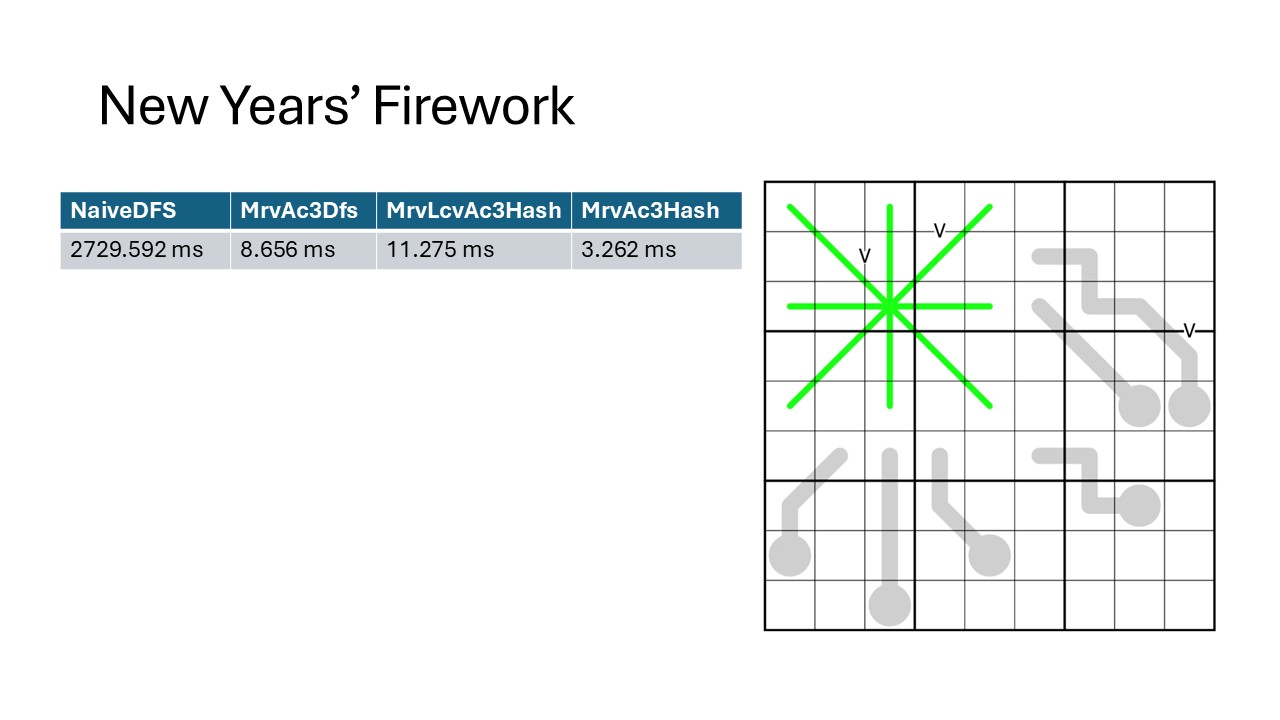
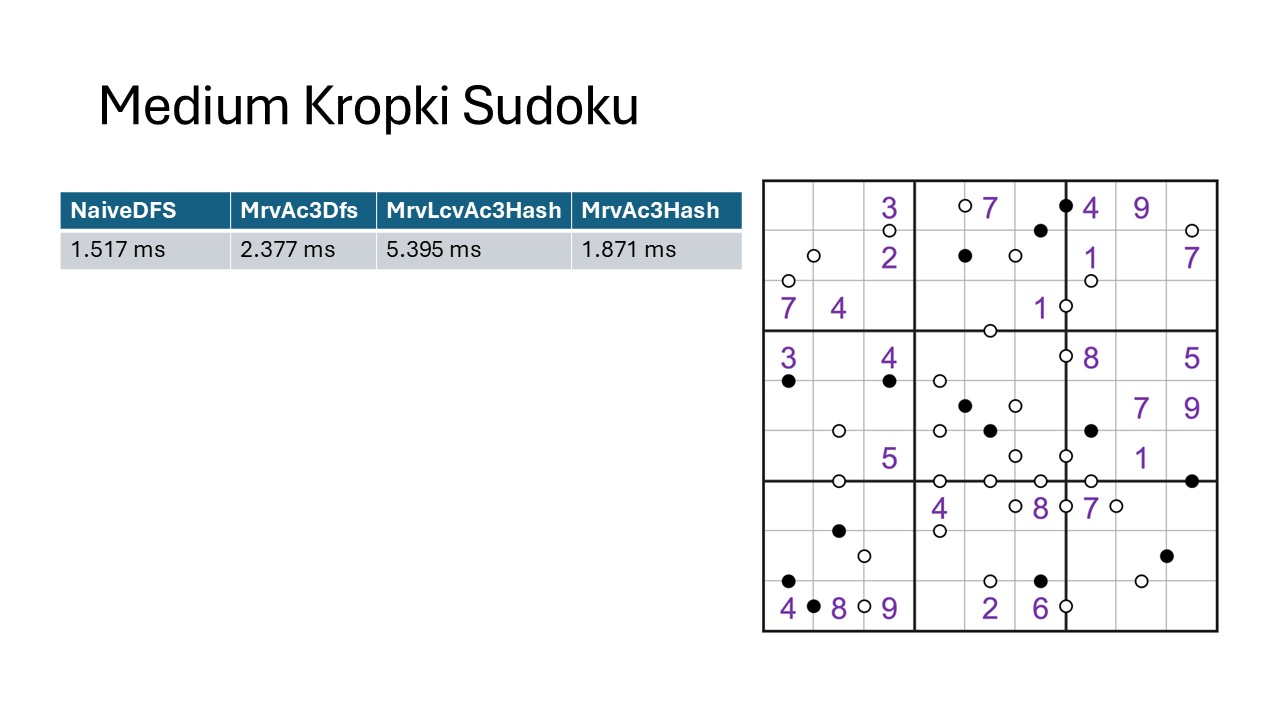
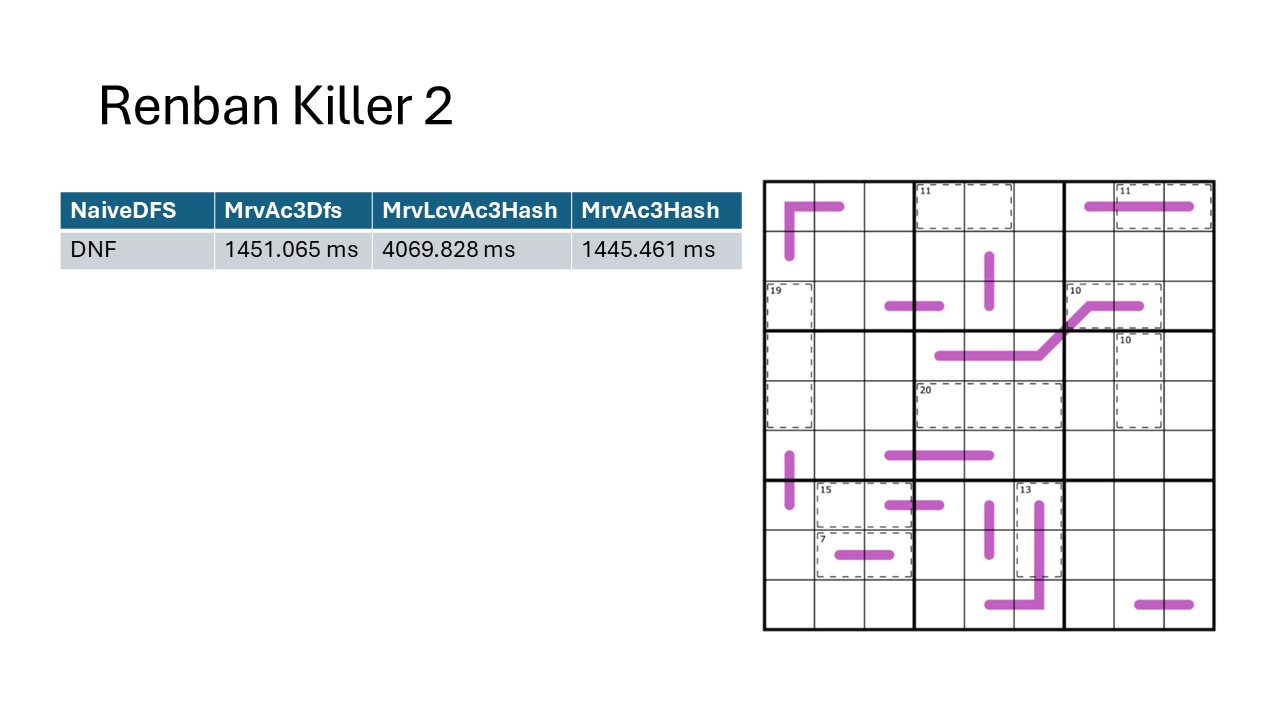
These result photos are taken directly from my project presentation in the AI course. They show the solve times of NaiveDFS (my first algorithm), MrvAc3Dfs (MRV heuristic with AC-3 constraint propagation), MrvLcvAc3Hash (MRV + LCV, AC3 propagation, and explored state mapping), and MrvAc3Hash (MrvAc3Dfs with explored state mapping). All experiments were run on my MacBook Air.
Future Improvements
- Stricter constraint validation + Constraint-rule library
- Uniqueness Checking
- Setting New Puzzles